The tomato plant does not care whether you pulled a weed with a fancy tool or a spoon from the kitchen drawer. Your hands, wrists, and knees do. The best garden tools for arthritis make the small, repeated motions of gardening less punishing, so you can keep growing food and flowers without paying for it later with a sore grip or aching joints.
📋 Table of Contents
- What Makes a Garden Tool Easier on Arthritic Hands?
- 10 Best Garden Tools for Arthritis
- 1. Ergonomic hand trowel
- 2. Ratchet pruners
- 3. Long-handled weeder
- 4. Stirrup hoe
- 5. Garden kneeler with side handles
- 6. Lightweight watering wand
- 7. Easi-grip or vertical-handle cultivator
- 8. Long-handled bulb planter or dibber
- 9. Garden cart or rolling seat
- 10. Grip aids and tool holders
- Set Up the Garden to Need Less Force
- A Few Habits That Protect Your Joints
The goal is not to buy every “arthritis-friendly” item on the shelf. It is to choose a few tools that reduce twisting, tight gripping, deep bending, and repetitive strain. A well-chosen trowel, pruner, or long-handled weeder can make a bigger difference than a garage full of gadgets.
What Makes a Garden Tool Easier on Arthritic Hands?
A tool is arthritis-friendly when it lets your hand stay in a more natural position and does more of the work for you. Look for a broad, cushioned grip that fills your palm without forcing your fingers to squeeze tightly. Handles with an angled or pistol-style shape can help keep your wrist straighter while digging, transplanting, or cultivating.
Weight matters, but lighter is not always better. An ultra-light tool that flexes, slips, or needs extra force can be more tiring than a slightly heavier, sturdy one. Aim for tools you can control comfortably. For hand tools, stainless steel heads are often a sensible choice because they resist rust, slide through soil smoothly, and last for years with basic care.
Also consider reach. A long handle can save your back and knees, but a handle that is too long may feel awkward in a small raised bed or crowded container garden. The right tool depends on your garden setup as much as your hands.
10 Best Garden Tools for Arthritis
1. Ergonomic hand trowel
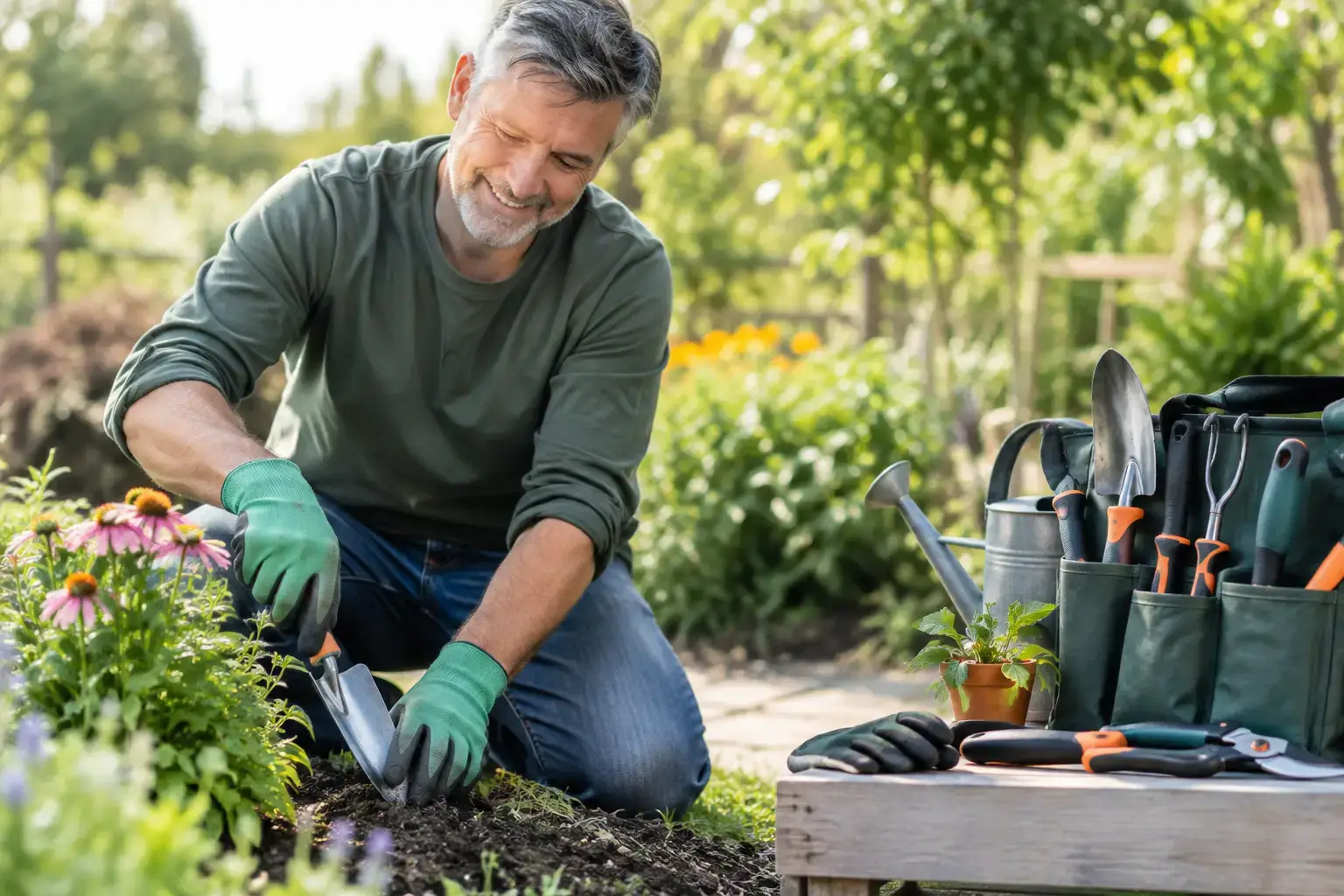
A good trowel is the workhorse of container gardens, raised beds, and planting days. Choose one with a thick, soft-grip handle and a slightly curved or angled shaft. That angle reduces the need to bend your wrist sharply while scooping compost, setting in herbs, or transplanting vegetable starts.
A narrow trowel is useful for working between established plants, while a wider blade moves more soil at once. If gripping is especially difficult, prioritize handle comfort over having the sharpest-looking blade.
2. Ratchet pruners
Pruning shears can be surprisingly hard on painful finger joints. Ratchet pruners cut in stages: you squeeze, release, and squeeze again rather than forcing one hard motion through a woody stem. They are especially helpful for deadheading, trimming raspberry canes, and cutting back spent tomato vines at the end of the season.
The trade-off is speed. Ratchet pruners are slower than bypass pruners for lots of tiny cuts. For most home gardens, though, the reduced hand strain is worth the extra few seconds.
3. Long-handled weeder
Weeding should not require kneeling over every dandelion. A stand-up weeder with a foot pedal or clawed head removes many tap-rooted weeds while you remain upright. This is particularly useful along paths, lawn edges, and open garden areas.
Use it when soil is slightly moist, not muddy. The roots release more easily, and you will not have to yank or twist as hard. In packed clay or between closely planted vegetables, a smaller hand weeder may still be the better fit.
4. Stirrup hoe
A stirrup hoe, also called an oscillating hoe, cuts young weeds just below the soil surface with a gentle push-pull motion. It is one of the most useful tools for gardeners who want to avoid both chemical herbicides and long sessions of hand pulling.
The secret is timing. Run it through beds when weeds are still threadlike or only an inch tall. At that stage, the hoe does the work with very little pressure, and you avoid the tough pulling that can irritate arthritic hands.
5. Garden kneeler with side handles
Arthritis does not always stay in the hands. A padded garden kneeler protects sore knees, while sturdy side handles give you something reliable to push against when standing back up. Many designs flip over into a low seat, which can be handy for planting bulbs or working in low beds.
Look for a kneeler with a firm frame rather than extra-thick but squishy foam alone. Stable support matters more than cushion when you are shifting your weight.
6. Lightweight watering wand
A watering wand with a thumb-controlled valve is much easier to manage than a heavy hose nozzle that requires a constant squeeze. Choose one with several spray patterns, especially a gentle shower setting for seedlings and newly transplanted vegetables.
A longer wand also lets you water the center of a bed without leaning in or stepping on the soil. Keep the hose as light as practical, too. Even the most comfortable nozzle cannot make dragging a heavy, kinked hose feel easy.
7. Easi-grip or vertical-handle cultivator
For loosening the top inch or two of soil, an upright-grip cultivator can reduce wrist twisting. These tools place the handle vertically above the tines, so you use more of your arm and shoulder rather than relying on a tight hand grip.
They are best for fluffing mulch, scratching in organic fertilizer, and breaking up small crusted areas. They are not meant to turn over a whole bed. Deep digging is usually unnecessary in a healthy, mulched garden anyway, and it can disturb soil structure.
8. Long-handled bulb planter or dibber
Planting a row of onions, garlic, or flower bulbs can mean dozens of repeated bends. A long-handled dibber makes consistent planting holes while standing, and a bulb planter with a foot step uses body weight rather than hand strength.
For vegetable starts, a simple narrow dibber is often enough. Make the hole, add the plant and compost, then gently firm the soil with an open palm instead of pinching and pressing with your fingertips.
9. Garden cart or rolling seat
Carrying bags of compost, harvested squash, tools, and watering cans adds up fast. A two-wheeled garden cart or rolling garden seat keeps supplies close and reduces trips back and forth across the yard. A rolling seat is especially useful in long rows or larger vegetable beds.
Choose wide wheels if your paths are grassy, mulched, or uneven. Small hard wheels work fine on a patio but can bog down in soft soil.
10. Grip aids and tool holders
Sometimes the simplest improvement is not a new tool. Foam grip tubing can enlarge a narrow handle, making it easier to hold without clenching. A wrist strap or tool holster can prevent drops and keep you from repeatedly reaching down for a trowel or pruners.
These small additions are especially helpful if you already own solid tools with handles that are just too slim. Test any added grip before a long session, since some materials become slippery when wet.
Set Up the Garden to Need Less Force
The best garden tools for arthritis work even better when the garden itself is easier to manage. Raised beds reduce bending, and beds no wider than about four feet let you reach the middle without stretching. Containers placed on benches, stools, or cinder blocks can bring herbs and salad greens closer to a comfortable working height.
Mulch is another quiet helper. A two- to three-inch layer of shredded leaves, untreated straw, or finished compost suppresses weeds, keeps soil from crusting, and holds moisture longer. That means less hoeing, less digging, and less hauling a hose around in hot weather.
Keep your most-used tools where you garden. A small weather-protected bin beside the raised beds may sound ordinary, but it prevents the extra walking and carrying that can turn a pleasant ten-minute task into a tiring chore.
A Few Habits That Protect Your Joints
Try to garden in shorter stretches rather than pushing through a full afternoon because the weather is nice. Twenty or thirty minutes of weeding followed by a break is often kinder to your hands than two hours of determined work. Switch tasks before one motion starts to ache: prune a few stems, water, harvest, then return to planting.
Use both hands when lifting pots or bags, and slide heavy containers across a bench when possible. For a pot that feels questionable, it is too heavy to lift alone. A hand truck, cart, or a second set of hands is part of smart gardening, not a shortcut.
If a tool causes sharp pain, numbness, or lingering soreness, stop using it. Comfort is personal, and a tool praised by another gardener may not suit your grip or range of motion. If arthritis symptoms are changing quickly or interfering with daily life, a clinician or occupational therapist can offer individualized advice on joint protection.
A garden does not need perfectly edged beds or every weed removed to be healthy and productive. Set out the tools that feel good in your hands, mulch the bare soil, and let the work happen at a pace your body can enjoy.