If you have ever gone out on a hot afternoon and found your raised beds dry as toast, you already know why drip irrigation for raised beds earns such a loyal following. Raised beds drain faster than in-ground gardens, which is great for root health but not so great when tomatoes, cucumbers, and lettuce all seem thirsty at once. A simple drip setup takes a daily chore and turns it into a steadier, gentler way to water – one that supports healthy plants without wasting water.
What makes raised beds a particularly good match for drip is control. Instead of spraying everything, including paths and weeds, you place water right where roots can use it. The soil stays more evenly moist, leaves stay drier, and you spend less time standing outside with a hose trying to guess what got enough.
Why drip irrigation for raised beds works so well
Raised beds warm up quickly in spring, drain efficiently, and let you grow intensively in a smaller space. Those are all real advantages, but they also mean the soil can dry out faster than many gardeners expect. Hand watering can work, especially for a bed or two, but it often becomes uneven. One corner gets soaked, another stays dry, and shallow-rooted crops suffer first.
Drip irrigation slows that whole cycle down. Water seeps into the soil instead of running off the surface, and it does so close to the base of the plant. That matters for vegetables because steady moisture supports better root growth, more even fruit development, and fewer stress-related problems. If you have ever dealt with bitter lettuce, split tomatoes, or cucumbers that stall in summer heat, inconsistent watering may have been part of the story.
There is also a plant-health benefit that organic gardeners appreciate. Wet foliage can invite fungal problems, especially when nights are warm and humid. Drip systems keep most of the moisture in the root zone, which helps reduce splash-up and leaf wetness. It will not solve every disease issue, but it does remove one common contributor.
Choosing the best drip irrigation for raised beds
The best setup depends on what you grow, how many beds you have, and whether your beds are all the same size. That is where gardeners sometimes get tripped up. There is no single perfect layout for every yard.
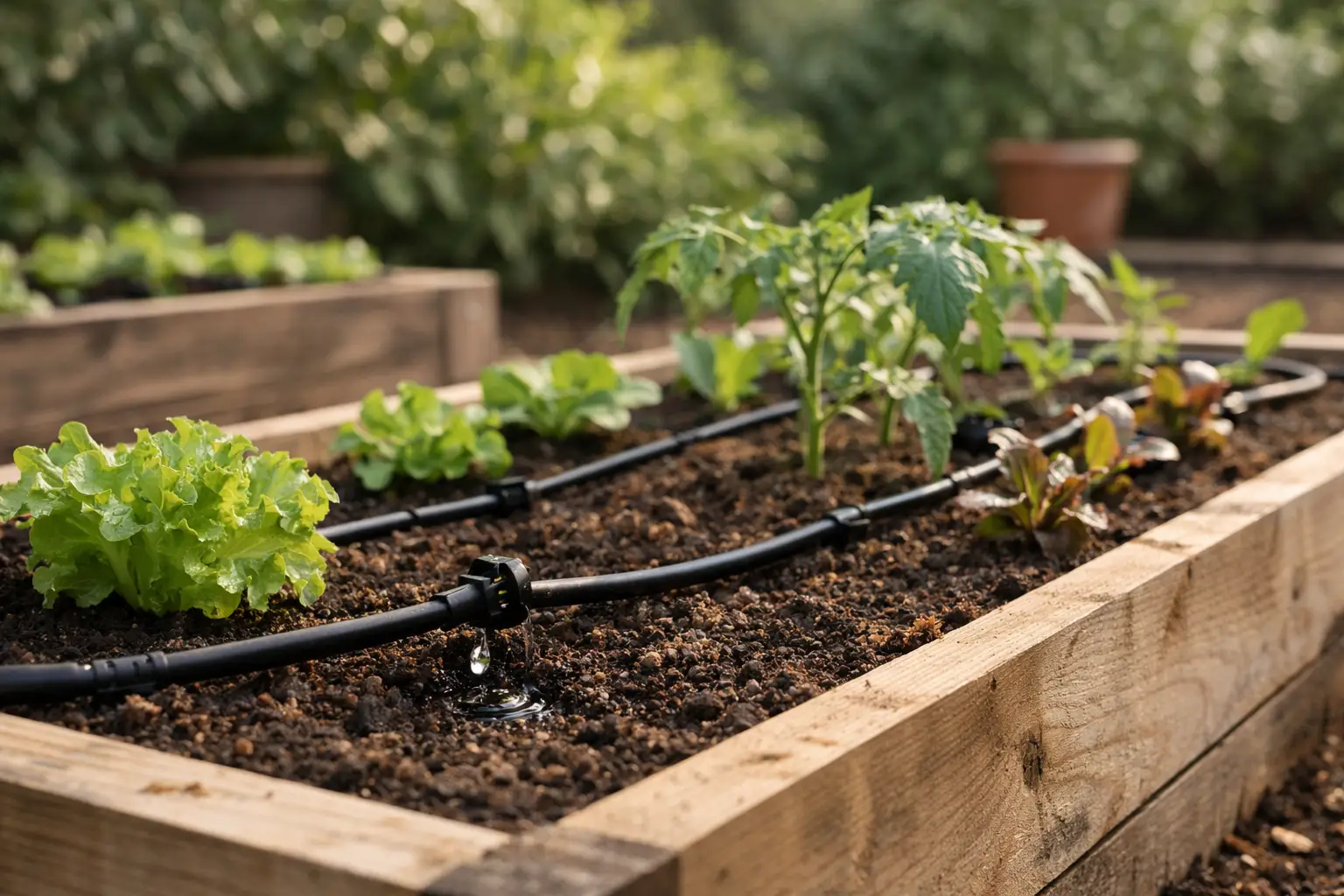
For most raised beds, two options work especially well: drip lines with built-in emitters, or plain tubing with individual emitters placed where needed. Drip line is the easier choice for beds planted closely with greens, beans, carrots, onions, or mixed vegetables. The emitters are spaced along the tubing, so you get broad, even coverage across the bed.
Individual emitters make more sense when plants are spaced farther apart, as with tomatoes, peppers, eggplant, squash, or large herbs. You can place water exactly where each root zone needs it. That keeps things efficient, though it does take a little more planning.
If you are a beginner, drip line is often the friendlier starting point. It is simpler to install, simpler to expand, and forgiving if your planting plan changes from season to season.
How to lay out a raised bed system
A straightforward layout is usually best. In a standard 4-by-8-foot raised bed, many gardeners do well with two or three runs of drip line spaced evenly across the width of the bed. If you grow densely, such as salad greens or root crops, three lines often give better coverage. If your soil holds moisture well and your crops are larger and more spaced out, two may be enough.
Try to keep the lines parallel and secure them so they stay in place when you plant, weed, or add mulch. Running the tubing under a light layer of mulch can help reduce evaporation and protect it from sun exposure. Straw, shredded leaves, or untreated mulch all pair nicely with drip because they help the soil stay moist between watering cycles.
A main supply line usually runs along the outside edge of the beds, with smaller lines feeding each bed. This keeps the system tidy and easier to troubleshoot. If one bed needs a change, you do not have to rebuild the whole garden.
Watering schedule: less guessing, better results
The biggest mistake with drip is assuming that because the system is running, the plants must be happy. Timing matters just as much as setup. Raised beds need regular checks because weather, mulch, plant size, and soil mix all affect how quickly moisture disappears.
Start by watering deeply enough to moisten the root zone, then adjust based on what the soil tells you. In mild spring weather, you may only need to run the system a few times a week. In peak summer, especially when beds are full and temperatures climb, daily watering may be appropriate for some crops. Sandy mixes need more frequent irrigation than beds with more compost and organic matter.
The easiest way to check is still the simplest one – stick your finger into the soil. If the top inch is dry but it is moist below that, you may be in good shape. If it is dry several inches down, the run time is probably too short. If the soil stays soggy and plants look unhappy, scale back. Even thirsty vegetables prefer oxygen around their roots.
Timers are helpful here, especially if you travel or just want consistency. They take human forgetfulness out of the equation. Still, they are not a set-it-and-ignore-it tool. A rainy week, a heat wave, or a new planting all call for adjustment.
Common mistakes with drip irrigation for raised beds
One of the most common problems is too little coverage. Gardeners install a single line down the middle of a wide bed, then wonder why the edges dry out. Water spreads through soil, but not infinitely. Beds need enough lines or emitters to match their width and planting density.
Another issue is treating all crops the same. Tomatoes and basil can often share a watering zone happily enough. Tomatoes and carrots, not always. Crops with different moisture needs may do better in separate beds or with separate zones if your layout allows it.
Clogging is another reality, especially if your water contains sediment or mineral buildup. A basic filter helps a lot, and flushing the lines now and then keeps the system running more evenly. It is a small maintenance job, but worth it.
Pressure matters too. Drip systems generally need pressure regulation to work properly. Without it, some emitters may blast while others barely drip. If a kit includes a pressure regulator, use it. If you are building your own system, do not skip that part to save a few dollars.
Making drip irrigation more organic-garden friendly
Drip already leans in a natural direction because it uses less water and supports healthier foliage, but a few choices make it work even better in an eco-conscious garden. Mulch is the first one. When you combine drip with mulch, you cut evaporation, moderate soil temperature, and reduce weeds all at once.
Healthy soil also changes how effective your system is. Beds rich in compost hold moisture more evenly than beds filled with a coarse, dry mix that sheds water too quickly. If your raised beds seem to dry out hours after watering, improving the soil may matter as much as changing the irrigation schedule.
It also helps to water early in the day. Even with drip, morning watering gives plants time to settle in before afternoon heat and helps avoid the damp overnight conditions that some diseases love. It is one of those simple habits that pays off quietly over time.
Is it worth the setup?
For one tiny bed, maybe not. A watering can might do the job just fine. But once you have multiple raised beds, summer crops, or a busy schedule, drip starts to feel less like a luxury and more like a practical tool.
It saves time, yes, but the bigger benefit is consistency. Gardens usually do better when watering is steady rather than heroic. A little every day at the root zone often beats the all-too-human pattern of forgetting for two days and then drenching everything on the third.
If you are building your first system, keep it simple. Start with one or two beds, watch how the soil responds, and make small adjustments. That is how most good garden systems come together anyway – not perfectly on day one, but better each season.
A raised bed should make gardening easier, not give you one more thing to manage. When your watering runs quietly in the background and your plants stop wilting by lunchtime, that is when drip really proves its value.